


How to choose skis for your holiday in the mountains?
Choosing the right skis for you


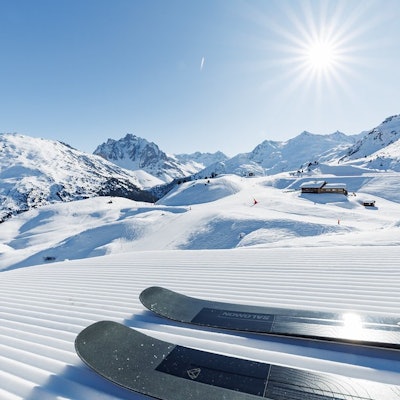
Your level of technique, your experience, your physical build, your budget and the characteristics of different skis all make up a unique puzzle. And each piece counts, when it comes to putting together your perfect equipment! This article unpicks all the criteria, whether you’re a beginner or expert, with an extra focus on children’s skis. Discover our useful advice and technical explanations as we help guide you to the perfect equipment choice.
Key points to consider:
Your level and how often you ski determine the type of equipment
Body type and budget also affect your choice
To buy, rent or acquire second hand? Each option has its advantages
Ready to find your ideal pair of skis?
The most important question: should you buy skis?
Before choosing your skis, here’s the main question: should you buy them or choose rental skis? Your answer depends on your personal situation and how often you ski.
If you ski less than 10 days per year, rental is almost certainly the best solution as it offers total flexibility:
Test different models depending on your preference each visit
Adapt your equipment to your level of progress
Avoid maintenance costs
The initial lower cost frees up your budget for other holiday expenses and fun in the mountains, such as your 3 Vallées ski pass.
It is generally considered that buying skis represents good value when you ski more than 15 days per year. You will benefit from personalised equipment, fitted to your requirements, with the overall cost lasting several seasons. But don’t forget: regular maintenance (waxing, grinding edges, repairs) represents an extra cost and constraint.
In Méribel-Mottaret and Les 3 Vallées, why not take the opportunity to try a ski test organised by brands or in local shops: a unique chance to test skis in real conditions. End of season sales can also offer great deals on last year’s models.
Don’t forget to read our ultimate checklist for packing for your ski holiday to help you remember everything you need!


What are the criteria for making the right choice?
Let’s look at the criteria for selecting skis. There are three factors for knowing how to choose skis for your mountain holidays: your personal preferences, your physical characteristics and the technical specifications of the skis themselves.
Each detail has a bearing on your future ski experience as soon as you take your skis out onto the pistes.
Let’s review
Your current level and how often you ski
Firstly, be honest with yourself: over-estimating your ability leads you to choosing skis that aren’t suitable and having frustrating days on the slopes. Here’s how to place yourself objectively:
Beginner: you have mastered snow-ploughs and ski on green runs
Intermediate: you can ski parallel turns on blue runs and have tried your first red runs
Advanced: at ease on red runs and have managed a few blacks successfully.
Expert: can descend any black run without major difficulties
Need a reminder on the colour coding of the ski slopes?
How often you ski also effects your choice:
Occasional skier (less than 5 days per year) calls for forgiving skis that can accommodate mistakes.
Regular skier (10-15 days per year) justifies a model that will accompany you in your progress
Intensive skier (20 days or more) merits a performance ski which responds to your technical demands.
Following this principle assures you an optimal, stress-free ski experience on the slopes of Les 3 Vallées.
Your physical characteristics (sex, height, weight…)
Are you 1.60m tall or 1.85m? Do you weigh 50kg or 85kg? These differences radically change the type of ski you need. Forget the idea that a good ski suits any skier: your body shape dictates the rules.
When it comes to length and stiffness, the logic follows your physique. A larger build puts more strain on your skis and demands more length and rigidity. On the other hand, a slimmer build will need shorter and more supple skis which react more easily to your movements.
This avoids the problem of overly flexible skis which don’t grip the piste adequately, or skis that are too straight and difficult to turn.
Manufacturers also design women’s skis. These models are lighter in construction and adapt to the female centre of gravity, and also recommend a different binding positioning. These technical adjustments genuinely improve comfort and performance.
The ratio of body type to flexibility: light build = flexible ski, strong build = stiff ski.
Comfort or performance?
Here’s the dilemma: looking for safety and comfort, or do you prefer excitement and performance? These are the priorities will which help you define your selection, so think carefully about your requirements:
Progression: technical evolution, building confidence
Safety: maximal stability, control under challenging conditions
Ease of use: intuitive equipment, predictable responses
Pushing the limits: reactive, precision and commitment
Which is your priority? This will determine the type of ski:
Looking for comfort and ease: try forgiving models which are stable and predictable. These skis will look after you if you are struggling with technique and ensure progression in safety.
Seeking performance: opt for a more technical model, precise and lively, with the latest innovations.
The technology involved varies according to this differentiation: anti-vibration systems, lighter core and reinforced parts characterise top-of-the-range skis. Models more aligned to comfort prioritise simplicity and versatility.
Certain brands offer hybrid technology which combines tolerance and reaction, ideal for those transitioning between intermediate and advanced level.
The price of skis
In terms of budget, what can you expect? Prices vary significantly according to your objectives and the technology of the equipment.
Here is a general overview:
Beginner: €150 to €300, for skis only or including basic bindings
Intermediate: €300 to €600 with technology supporting progression
Expert: €600 to €1200, for top level equipment and the latest innovations
A pack with bindings included: allow €100 to €400 extra according to quality
Technological innovation and premium materials justify these price differences. When it comes to a solid wood core, carbon fibre, anti-vibration systems, each improvement has its price.
Calculate value over time and usage. An occasional skier would not get much return on a top-level ski, however a regular to the 3 Valleys would balance out the cost of the investment more quickly.
Don’t forget the extra costs: there’s the servicing and repairs, plus the improvement in your technique could mean you need to change skis before they wear out.
Understanding the parts of a ski
Tip, tail, rocker, side cut, turning radius, camber… Faced with technical vocabulary which all sounds like jargon? Let’s take a look at what these terms mean, they’ll be key to your future fun on the slopes:
Side cut or waist: the width of the centre of the ski, determines the turning circle and grip
Tip: the front part which supports the initiation of the turn
Rocker: inverse curve at the tip or heel which facilitates change of direction
Camber: the classic curve which distributes pressure down the whole length
Turning radius: determines the ease of the turn; a short turning radius is good for quick, short turns
Tail: back of the ski, has an influence on the exit from the turn and stability
It’s the width of the ski which influences how the ski reacts. A straighter ski (less than 80mm waist) offers precision on a groomed slope, whereas a wider ski (waist of 100mm or over) helps in powder snow but might make turning on hard snow more difficult.
As for the length, this is chosen according to your level and required usage:
Beginners: ski length between the chest and the chin
Intermediate: between the chin and the nose
Advanced: from the nose to just above the forehead
This rule adapts to your body type and personal preferences.
Ski types
Each discipline has its own requirements in terms of equipment. Here’s a guide to the different categories according to what type of skiing you want to do, and the playground in which you want to ski:
Piste skiing (alpine): maximum precision, reliable grip, manoeuvrability on groomed snow
All mountain skiing: total versatility, adapted to all types of snow and terrain
Freeride skiing: wide ski, exceptional handling in powder, increased rigidity
Freestyle skiing: twin-tips to ski forwards and backwards (‘switch’), lightness, resistant to impact in eg. the Open Park
Ski touring: extremely light, special bindings to facilitate walking up and skiing down, prioritises uphill over downhill performance
Mini skis/snowblades: easy to learn, extremely manoeuvrable, quick progression
Children’s skis: adapted proportions, tailored flexibility, reinforced safety
The piste ski reigns on the groomed runs of Méribel-Mottaret thanks to its stiff construction and grippy edges. The all-mountain ski seduces those who want to explore everywhere, alternating between piste and off-piste according to conditions. A freeride ski excels floating in the deep powder but needs careful handling on hard pistes. Freestyle skis reveal their advantages in the snowpark thanks to their symmetrical construction and resistance to impact. The touring ski opens the doors to a wilder side of the mountain, but does compromise on performance in descent.
Is it better to get new or second-hand?
Should you buy a new pair of skis or choose second hand instead? The answer depends on your wallet, your level, and how often you ski.
Here are the advantages and disadvantages of each option:
- Complete guarantee from manufacturer
- Never used, optimal performance
- Bigger choice of models and colours
- Higher price but a long-lasting investment
Buying new gives you access to the latest technology: new materials, re-designed geometry, innovations to aid progression. Such evolutions can justify the extra investment, especially if you will regularly be skiing on the slopes of the 3 Vallées.
- Price divided by two or three
- Condition varies depending on previous servicing
- Choice limited to models available
- No guarantee, hidden risk
Buying second hand requires vigilance. Check these points before buying:
- General state: cracks, knocks or delamination
- Base: deep scrapes, visible repairs
- Edges: blunting, missing parts, rust
- Bindings: wear and tear of mechanism, compatibility with your ski boots
Choose professional vendors who test the equipment and know the history. Avoid suspicious adverts without the option to test – testing a ski in store avoids unpleasant surprises.
How to choose children’s skis?
Choosing skis for children requires a very different approach. Forget the criteria you’d use for your own skis, here it is safety and fun that are more important than performance.
The size guide follows the age and the ski level:
Beginners from 3 to 6 years: skis between the chest and the chin.
Children progressing further aged 6 to 10: between the chin and nose according to their ability.
Over 10 years with a good level: between the nose and eyes.
Just as with adults, this rule should be adapted according to the body type, their weight and their ski level.
Your choice should be guided by safety and ease of use. Choose a flexible model which is easy to turn and forgives any technique problems. Choose skis to encourage confidence not incur frustration.
The design of children's bindings meets specific technical requirements, including increased safety with more sensitive release and easy adjustment as children grow. They can also be quickly adapted to changing shoe sizes.
Winning strategies to encourage progression and fun on skis:
Try before you buy in a reputable shop
Rent for the first year to test preferences
Consider accessories like harnesses to help very young children
Renew equipment often as the child grows
Need personalised advice? Specialist shops in Méribel-Mottaret can analyse the body shape and ski level of your child, Their expertise will help avoid costly errors and maximise their chance of success on the slopes in Les 3 Vallées.


