Off-piste skiing in Méribel
Making fresh tracks in the powder snow
Waking up to powder = big ideas
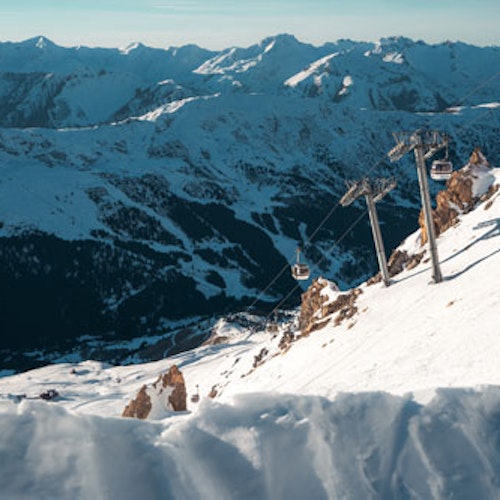
This morning, Méribel has awoken under a beautiful blanket of fresh snow. Dream conditions that just make me want to explore and venture a little further from the groomed pistes. Even before putting my ski boots on, I feel the pull of that fresh powder: making those first turns, feeling virgin snow under my skis, sliding freely… I can picture myself there, carried by the mountain through every turn.
But before heading out, I start with the basics:
First things first: I seek information.
I check out the detailed weather forecast, find out how the temperatures will evolve, the strength and direction of the wind, and above all the Avalanche Risk Assessment Bulletin (Bulletin d’Estimation du Risque d’Avalanches or ‘BERA’): indispensable when it comes to understanding where conditions are stable – and unstable – on the mountain. I don’t hesitate to check with local mountain experts (ski patrollers, professional guides or ski instructors) to check the avalanche activity and find out the risks.
I get my kit together, not forgetting anything.
I go through the ritual of checking my equipment: testing my avalanche transceiver, checking that my shovel and probe are packed, and that my communication tools are charged and working. All simple tasks but each one can save lives. I know my safety depends as much on my vigilance as on the mountain itself.
I never go alone.
I never even think about going alone. The mountains are beautiful, but demand care and respect. When I’m not with experienced friends, I prefer to go with a mountain guide or ski instructor. Their presence assures my safety as well as giving me a lesson in riding the terrain.
Then before leaving, I always take the time to double check conditions again. It’s only once I have been through this process that I feel ready to head out into the fresh powder in Méribel. Once I leave those marked pistes, the mountain becomes a wild and challenging place.
Leaving the marked pistes: freedom… and responsibility
Once I’ve clipped into my bindings, I make a relaxed start to wake up the legs and get a feel for the day’s snow. Then, little-by-little, my eyes wander to the sides, to those less tracked, wilder areas off-piste where the snow looks lighter and more natural. When I slide over, I feel the change straight away: no more signposts or safety netting, no more reassuring framework. The mountain expresses itself differently, and each decision counts.
Around Méribel certain off-piste areas are easily and almost naturally accessible. Others take me further into spaces where orientation and understanding and reading the mountain becomes essential. If clouds or fog descend, if fresh snow blanks out the terrain’s natural features or if the day becomes a white-out, I know it’s time to quit. Closed runs and preventative avalanche blasting are the essential signs it’s time to head home, and I respect these, no matter what.
I take time to observe, discuss with my group, and make the most of each moment. For me, off-piste is not a performance or race: it’s a moment of communion with the mountain, a balance between pleasure and clarity. And if I’m still not sure, I never hesitate to ask advice from the ski patrollers. Their knowledge and experience of the terrain can help me avoid mistakes and help me fully enjoy the mountain, in complete safety.
In summary, going off-piste starts before I get my skis on:
I know how to use my avalanche gear, and I practice regularly so it becomes a reflex.
I take the time to ask local mountain professionals about conditions, evaluate the risks and prepare to go off-piste in safety.


Nature first: skiing respectfully
How to avoid disturbing the living mountain
Skiing off-piste in Méribel not only means skiing fresh powder, but also feeling the mountain breathing around me. As soon as I leave the marked pistes, everything becomes alive: the wind on my face, the snow crunching beneath my feet, the murmur of the changing mountains, and sometimes the fleeting passage of a chamois or hare disappearing into the trees. Certain areas, like the natural reserve of the Plan de Tuéda in Méribel-Mottaret are no-ski zones. Each space has its reason to be. Here, each animal counts, each gesture has an impact.
In winter, the cold is intense, food is scarce, and every time an animal is disturbed, it dispenses energy. Even if I don’t intend to or never even notice, going too close compromises their survival.
When I’m skiing, I always keep in mind that we must share the mountains. Respecting the protected areas means staying away from a beautiful looking line in order to leave wildlife undisturbed. And honestly, it’s no big deal, in fact it gives my day even more meaning.
Leave only tracks
I’m talking particularly about the protected zone near to the Mont Vallon gondola and the Mûres Rouges chairlift. They’re clearly marked on the piste map, but the area can look very tempting. Even so, I never go into that zone. By leaving this space – and other similar zones – undisturbed, the wildlife can feed safely, rest, and survive the harsh winter conditions.
Outside of these zones, the off-piste options are infinite. But still, I’m not seeking speed or performance: I take the time to look at the snow, listen to the wind, chat with my group. When everything aligns and conditions are perfect, each descent is a moment when time stops, each turn is engraved into my memory.
At the end of the day, I head home with tired legs but a smile on my face. In Méribel, enjoying the off-piste is an incredible adventure, but only if I am well-prepared and stay attentive and respectful. Days like these, simple but intense, make memories to last a lifetime.
To gain more knowledge about going off-piste safely, see more practical advice on the official website.