Ski vs snowboard what are the differences? How to choose?
What are the fundamental differences between skiing and snowboarding?
Not sure whether to ski or snowboard before your next trip to the best resort in the Alps? Understanding the differences between them is the best way to put you on the right track.
Already, the equipment differs radically, the posture on the snow changes completely and the culture surrounding each practice diverges. But let's get into the details.
Equipment and clothing differences
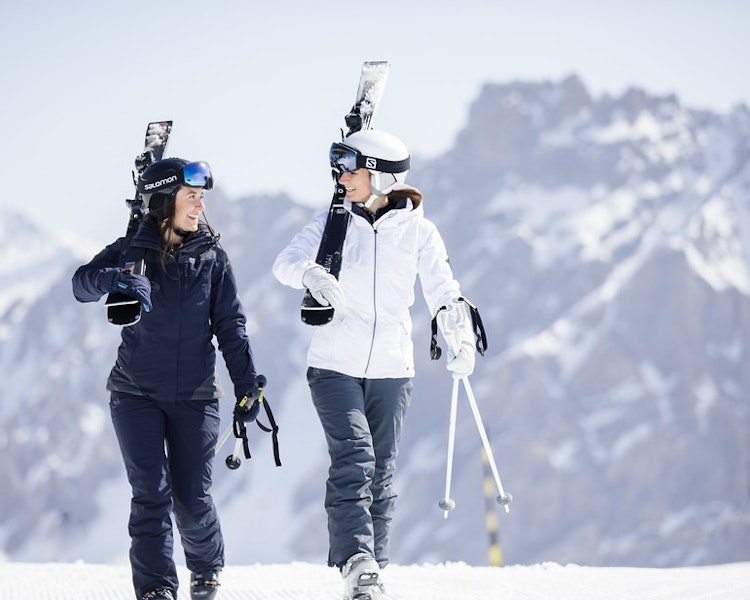
Your equipment changes dramatically depending on the discipline you choose. On skis, you take two separate skis, a pair of poles and rigid boots that hold your ankles firmly in place. For snowboarding, you attach both feet to a single board, the soft boots wrap comfortably around your ankles, and there are no poles to encumber your hands.
Both disciplines share the same protective equipment helmet, face mask, waterproof jackets and pants, back protectors, gloves and thermal underwear.
The real difference in comfort? Your ski boots give you the impression of walking on concrete soles, while your snowboard boots allow you to walk almost normally in the resort.
Criteria | Ski | Snowboard |
|---|---|---|
Slide support | Two independent skis | A single board |
Shoes | Rigid shoes with plastic shell, firm support, difficult walking | Soft boots, greater comfort, easier walking |
Sticks | Two sticks to help with balance and movement | No sticks, hands-free |
Fasteners | Automatic triggering in the event of a fall, DIN setting | Strap or quick-release fasteners, manual release |
Differences in style and culture
Beyond the equipment, your relationship with the mountain and your movements on the snow vary fundamentally. These technical differences shape two distinct board sports cultures.
Skiing embodies a certain classic elegance, inherited from decades of practice in the Alps. Snowboarding, on the other hand, is more about creative freedom, inspired by skateboarding and surfing. These cultural differences are gradually disappearing: today, skiers and snowboarders live in harmony on the 3 Vallées slopes united by the same passion for sliding.
Aspect | Ski | Snowboard |
|---|---|---|
Body position | Facing the slope, natural panoramic view | Lateral position, head rotation required |
Balance management | Weight distributed over two independent supports for easy correction | Weight on one support, delicate lateral balance |
Gliding dynamics | Alternating left-right turns, progressive weight transfers | Linking S-curves, natural carving |
Image and culture | Alpine tradition, elegance, enhanced technicality | Freestyle culture, creativity, surf spirit |


Which sport is easiest to learn?
Wondering which discipline will make you progress fastest? The answer depends on your patience and expectations. Skiing makes it easy to get started with reassuring first glides, while snowboarding requires more determination at the outset before rewarding you quickly.
Learning curve: first days and weeks
Your first few hours on the snow will take you on diametrically opposed trajectories, depending on your choice.
On skis, you quickly link up short snowplough runsyou control your speed instinctively, and you're often down a green slope by the first afternoon. Facing the slope gives you a natural view of the terrain, and both legs move independently, spontaneously correcting any imbalances.
Snowboarding confronts you with a harsher reality when you first start out. You fall a lot, especially on your buttocks and knees. Lateral balance completely destabilizes your usual reference points; you have to turn your head all the time, and every mistake sends you to the ground. Once you've mastered these basics, your progress accelerates spectacularly.
Your previous skills play a part in this equation. If you've already been inline skating, skateboarding or surfing, your body already knows lateral balance and you'll progress faster in snowboarding. A grounding in skating or water skiing gives you an edge in downhill skiing.
Criteria | Ski | Snowboard |
|---|---|---|
The first day | Snowploughing down green slopes, fast control feel | Frequent falls, difficulty standing |
First week | Parallel turns on blue runs, autonomy on the Martre piste at Méribel-Mottaret | First turns mastered, descent of the blue runs at the end of the week |
Field vision | Full peripheral vision, easy anticipation | Constant head rotation, blind-side blind spot |
Freedom of movement | Independent legs, natural correction | Feet together, global body adjustments |
Average time blue run | 2 to 3 days of practice | 4 to 6 days of practice |



What's the right age to start?
Your children can start skiing as early as age 3 in kindergartens and Piou Piou clubs. At this age, their psychomotor development gives them the necessary balance and coordination. Little skiers move around in safe spaces and progress at their own pace, thanks to instructors who turn learning into play.
Snowboarding requires more physical and mental maturity. Snow schools generally welcome children from the age of 4. This is the age at which their musculature, lateral balance and ability to concentrate reach the required level. Before this age, the biomechanical demands of snowboarding exceed their abilities: balancing on a single lateral board requires well-developed abdominal and postural muscles.
How do you progress in each of these two disciplines?
Once you've learned the basics, skiing opens endless doors. Your technical progress continues season after season, each turn is refined and you gradually discover all the facets of alpine skiing:
Slalom and carving on prepared slopes
Freestyle with jumps and figures in Méribel-Mottaret Open Park
Morning hikes and climbs
And many other disciplines such as mogul skiing, freeride..
Snowboarding gets you off the ground quickly after a slow start. Once you've mastered lateral balance, you're ready for the joys of powder and freestyle. The board naturally excels in fresh snow, where it floats better than skis, and in snowparks, where it allows fluid rotations.
Sensations evolve differently depending on your choice. On skis, you gain in precision, speed and versatility over the years. With snowboarding, you experience a sudden change: from one day to the next, you're literally riding the snow with a feeling of total freedom.
Both disciplines offer structured paths to improvement:
Advanced courses with qualified instructors
Themed off-piste or freestyle courses
Local clubs and associations
Amateur competitions and time trials
Your personal investment determines the speed of your progress. A few days a year are enough to maintain your level, while regular stays in Les 3 Vallées will quickly propel you towards expertise.
Knowledge choosing the right time to go skiing also influences your learning.
What types of trails and terrain should I choose?
The terrain you ride on inevitably influences both your enjoyment and your performance.
Skiing gives you a clear advantage on hard-packed and groomed snow: your edges bite firmly into the morning ice, you keep control on icy slopes, and you adapt easily to all types of terrain. The red and black runs of Méribel-Mottaret can be tackled with greater precision on skis, especially at the end of the day when the snow becomes firmer.
Snowboarding truly reveals its magic in opposite conditions. You float in fresh powder, surf on soft snow, and express yourself freely in the snowparks of the 3 Vallées. The width of your board provides greater flotation in deep snow, where skis tend to sink and require more effort.
Off-piste skiing opens up different possibilities depending on your discipline. Touring skis take you far, as they allow you to climb easily and descend in all types of snow. A splitboard cuts your board into two parts that become uphill skis, but this solution is heavier and less common.
Warning: Off-piste skiing involves a risk of avalanches, regardless of your equipment. You must be supervised by a professional guide or instructor and be equipped with an avalanche transceiver (beacon), a shovel, a probe, and a means of communication. Weather conditions and Avalanche Risk Bulletins must be systematically checked before every outing.
So, snowboard team or ski team?
Here are some questions to ask yourself when choosing between skiing and snowboarding:
Looking for versatility, speed and steady technical progress? Skiing is for you.
Do you like the feeling of surfing? Do you prefer creativity and self-expression? If so, snowboarding may be just what you're looking for.
Would you like to get off to an easy start with your children aged 3 and over, and ski as a family? Skiing is the obvious choice.
You've already surfed or skated and you're looking for similar sensations in the mountains? Then snowboarding is just the thing for you.
FAQ: Choosing between skiing and snowboarding
Which discipline is the most popular and why?
Skiing dominates in France and in Les 3 Vallées the majority of snowboarders are skiers rather than snowboarders. This predominance can be explained by a centuries-old Alpine tradition:
Skiing is part of France's cultural heritage
The first stations were designed around this discipline
Infrastructures have developed along these lines
The teaching offer also plays a decisive role in this distribution. French ski schools welcome children as young as 3 in their kindergartens and Piou Piou clubs, while snowboard lessons generally start at around 7-8 years of age. This early access makes families loyal to skiing from an early age.
Physical accessibility reinforces this trend ski rental: ski rental is easier in all resorts, with equipment available everywhere and competitive prices. Snowboarding, on the other hand, sometimes requires a bit more research, especially in smaller rental shops.
The situation is reversed in some parts of the world. North America and Japan have much higher snowboarding rates, sometimes as high as 40%. Surfing and skateboarding culture is more deeply rooted in these countries, snowparks are flourishing and snowboarding education has taken shape earlier.
Current trends show a slight upturn in snowboarding among the younger generation, who see it as a more creative and less traditional discipline. Fashion and the image conveyed by social networks influence these new choices.
Can I ski and snowboard in the same group?
Absolutely, and this mix works very well on the Méribel-Mottaret slopes and in Les 3 Vallées. Both disciplines use the same slopes, lifts and areas.
Organization on the lifts just needs a little attention. Chairlifts and gondolas welcome everyone without distinction, but surface lifts make life difficult for snowboarders who have to take off one foot. Choose seated lifts for shared itineraries.
Managing rhythms also requires a little flexibility snowboarders take longer to put on their equipment, so be prepared for these minor delays. Otherwise, there are advantages to mixing: everyone discovers the other discipline, and you exchange impressions. Many people end up trying the other discipline after observing their friends.
Is it possible to change disciplines during a stay?
You can change discipline whenever you like a day's rental gives you total freedom. Try skiing for the first three days, then switch to snowboarding if you feel like it. Hire companies are happy to swap out your equipment, sometimes for a small extra charge depending on the price.
This flexibility helps you compare the two disciplines before investing in your own equipment.
Which discipline is the least risky for your joints?
Snowboarding is better for your knees, which take less twisting and direct impact. Your cruciate ligaments will thank you if you've ever been weak in this area. On the other hand, your wrists and shoulders suffer more trauma from frequent backward falls.
Skiing puts intense strain on your knees and ankles, but spares your wrists.
It's your personal medical history that really guides this choice.
Is it easier to progress off-piste on skis or snowboard?
With touring skis, it's easy to go off-piste. You can explore more terrain, alternate between ascents and descents, and adapt your itinerary freely. Snowboarding requires either a splitboard (heavier and more technical), or snowshoeing with your board on your back.
Once in the powder, the board floats better than conventional skis.