Colour codes for ski runs: All you need to know to be prepared
Riding in Technicolour
Our aim? To help you prepare your trip to Méribel-Mottaret, Les 3 Vallées or further afield, by decoding the secrets of the coloured signs. Gone are the days of scratching your head in front of the piste map!
Here’s what you’ll discover:
The meaning of each colour, its difficulty level and any hidden traps
The differences between French ski resorts and ski run colours across Europe
The indictators to help you progress to the next level at the right time
Understanding this topic will help you avoid unpleasant surprises and optimise your enjoyment on the slopes. In addition, our 3 Vallées ski passes can similarly adapt to all levels!
Ready to become an expert on those ski slope colours?
Slope comparison across ski resorts
If you are not sure how to choose which 3 Vallées ski resort to ski in, let us help with some numbers which might simplify your choice. You can plan your winter holiday according to your level.
- 23 green runs perfect for learning
- 38 blue runs, a playground for intermediates
- 33 varied and technical red runs
- 11 black runs including the challenging Eclipse
- 8 green runs including the famous Little Himalaya
- 27 blue runs, perfect for progression
- 27 red runs including ‘Combe du Vallon’, a very long descent on the glacier
- 10 black runs including the legendary Bartavelle
- 10 safe green runs
- 36 large blue runs
- 20 panoramic red runs
- 8 technical black runs
- 10 spacious green runs
- 32 blue runs, paradise for skiers to progress
- 25 red runs including ‘Christine’, one of the longest in the domain.
- 7 black runs
- 2 green runs for a gentle initiation
- 3 panoramic blue runs, ideal to progress at your own pace
- 3 dynamic red runs, perfect for those looking for rhythmic turns
- 1 challenging black run to give you a technical descent
This harmonious balance places Méribel-Mottaret at the heart of all the levels with ideal access to the whole of the largest ski area in the world. Discover more details on our piste map.
How do I know when I’m ready to go up to the next level?
Breaking through to a harder piste colour level requires an honest evaluation of your technical and mental techniques. Don’t rush yourself.
On the technical side, there are certain obvious signs:
At your current level, have you mastered a snow plough with ease?
Are your parallel turns becoming natural and fluid?
Can you control your speed without major effort, especially in narrow or busy areas?
These are the green lights that signal you are making solid and sustainable progress.
Reaching the next level requires more than just technique. It’s your self confidence that will also play a crucial role in your progression. Gaining versatility by being comfortable in a variety of snow conditions is essential, from morning powder to slightly icy afternoon snow.
Be careful of the day-to-day traps that can lead to false judgement! Fatigue has a direct influence on your capabilities. A tiring day is not the right moment to test yourself on a higher level. Equally, weather and visibility can dramatically change your perception of the difficulties. Thick fog or fresh snow can complicate everything, even pistes with which you are familiar.
Our most important piece of advice: ask a ski instructor who knows the resort. Local professionals can quickly identify your areas for improvement and steer you towards making the next steps. A lesson or course often reveals unexpected technical details that will unlock your ability to progress.
Finally, don’t forget that working on your fitness supports the evolution of your technique. Toned muscles and built-up stamina give you an extra margin against new challenges on the slopes.


The colour of the piste is not the only thing to take into consideration
Were you thinking that the ski slope colour was the only important indicator of difficulty? In reality, things are a lot more nuanced. Other factors influence the difficulty of a piste, even on a slope you know by heart.
Weather conditions will have an impact on your experience:
A familiar blue run needs much more care if there is thick fog
An accessible red can be made harder on icy mornings
Fresh snow can make your skis heavy and mask the undulations on any ski slope
Busy conditions also change the way you ski. An empty black run means you can let go and ski, but a busy blue run requires a lot more vigilance. The wideness of a slope also has an effect: narrow areas and bottlenecks slow down progress along an otherwise straightforward run.
Some technical features aren’t covered by the colour code. Natural bumps or moguls, changes in steepness, shady areas which become icier, there are numerous aspects to look out for that could make the ski run more difficult than the colour code suggests.
Remember that each ski area applies its own criteria. Certain resorts adopt rigorous classification; others are more flexible. The piste maintenance also varies depending on the sectors or areas, and the impact of sun or wind changes the snow condition during the day.
Your best way to stay on top of information and stay safe? Regularly consult the daily weather report and snow bulletin then chat with the ski patrollers: local professionals know the unusual features of each run and will advise you according to the conditions on the day.


Some ski slopes have colours and names as well as numbers. What are they for?


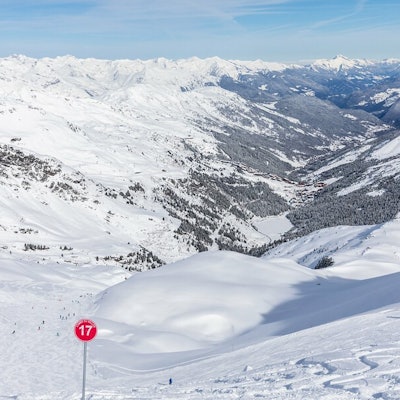
We have been explaining the colours of the ski slopes, but maybe you have also noticed that the coloured signs also have other information? Each sign is part of an ingenious system for orientation and safety.
Each piste marker comprises a disc or sign mounted on a pole. The colour indicates the difficulty level: green, blue, red or black. The name of the ski slope appears in white lettering, eg. "Bartavelle", "Little Himalaya", "Venturon". Below, a number with up to two or three figures identifies precisely a certain part of the run.
These numbers follow a logical progression. From the top, they get smaller until they read the bottom, so the high numbers appear at the start of the run and number 1 is closest to the finish. You can use them for meeting up when skiing as a group: “See you at number 12 on Martre in 30 minutes”. And parents teach this system to children to help them gain independence on the slopes, little by little.
In case of an accident on the slopes, the precise area of the accident is vital. Contact the ski rescue services (find the number on the piste map or on your ski pass) and clearly inform them which ski slope and number sign you are nearest to: “Accident on the red run Bartavelle, number 8, on the right side of the slope.” Ski patrollers know this network like the back of their hand and can quickly arrive at the precise location.
Is the colour code international, ie. the same all around the world?
Skiing in another country in Europe? Be aware that the colour codes might be different! Each region has its own classification of ski slopes, with categories that could create some surprises.
Here are the main differences in European and International countries:
France: our classic green-blue-red-black system, the most common in Europe
Italy and Switzerland: similar codes to France
Austria and Germany: only 3 colours: blue, red and black
Scandinavia: addition of yellow ski runs for non-groomed, often steep slopes
North America has its own system with distinctive shapes:
Green circle for beginners
Blue square for intermediates, the North American equivalent of a blue slope
Black lozenge for experts
Double or triple black diamond for extreme skiers
These variations can be explained by national norms such as:
AFNOR in France
DIN in Germany
ÖNORM in Austria
Each standard influences the perceived difficulty.
How can you ensure your safety on the slopes? Consult the piste map when you arrive. Head to the Tourist Office or talk to local ski instructors to gain specific area information. This precaution helps you avoid unpleasant surprises and helps you adapt your level to the local standards.