Ski sharpening and waxing: how to proceed?
Sharpening, honing, waxing... What are the differences?
Ski edge sharpening, sometimes called honing, works directly on your metal edges. These edges are what give you grip on the snow. Sharpening restores a precise, almost razor-like bite—essential for handling technical turns and icy slopes.
Without sharp edges, your skis tend to skid sideways instead of carving cleanly into the snow.
Ski waxing, on the other hand, focuses on the base. This layer underneath your skis needs regular treatment with wax, which acts as both protection and performance enhancer. Waxing improves glide, prevents oxidation, and extends the life of the base.
The result? More speed and less friction slowing you down.
It’s the combination of both that really makes the difference:
Sharpening without waxing leaves your bases unprotected
Waxing without sharpening reduces control, especially in turns
Ideally, both should be done during the same maintenance session. Your skis will then perform at their best again—just like on day one on the slopes of Méribel and Les 3 Vallées.
Why sharpen and wax your skis regularly?
You have just invested in a nice pair of skis one day, your skis skid strangely on a bend.
Regular maintenance of your skis is not a perfectionist's whim: it directly conditions your safety and your sensations on the snow. Let's take a look at what you gain by maintaining your equipment.
Frequent maintenance reduces the risk of falls or loss of controlespecially when you're embarking on a descent that's a little too ambitious. Well-followed skis react at a moment's notice instead of betraying you in the middle of a turn - because nobody wants to be overtaken by their own skis. And as a bonus, your equipment lives longer: a real relief for your wallet, which will almost thank you warmly.
In short, regular maintenance of your skis is your guarantee of maximum enjoyment and safety on the slopes.
Profit | Technical impact | Practical impact |
|---|---|---|
Optimized grip | Sharp edges that bite through hard or icy snow | Control your trajectories on demanding slopes |
Enhanced handling | More precise turns, more responsive skis | You can link curves with fluidity, even on the black Bartavelle piste at Méribel-Mottaret |
Preserved glide | A waxed sole keeps your speed up | You glide effortlessly and save energy |
Longer service life | Protection against oxidation and premature wear | Reduce your long-term maintenance costs |


When and how often should you sharpen and wax your skis?
Some warning signs tell you it’s time to service your skis. Learn to spot them before your next run turns into a nightmare.
Start with a simple test: run your fingernail along the edge. If it barely catches—or if you notice burrs or rough spots—your skis are due for some maintenance. Other signs are just as telling:
Loss of grip in turns
Skis that drift sideways instead of holding a clean line
Difficulty turning, even on easy (blue) runs
Dull or rusty edges
As a rule of thumb, sharpen your edges every 5 to 10 days on the slopes. Skiing on icy snow? Shorten that interval, as edges wear down faster in these conditions.
Waxing should ideally be done every time you sharpen your edges, or at least every 3 to 5 ski days. It’s also a good idea to schedule a session at the beginning and end of the season.
Some skiers will need more frequent maintenance. Advanced riders and heavy users tend to service their skis almost systematically. Harsh conditions—whether abrasive artificial snow, deep powder, or rugged off-piste terrain—accelerate wear on both edges and bases.
Is waxing and sharpening skis expensive?
What’s your budget? It depends on the plan you choose. There are three options available, each offering its own mix of cost and convenience.
Option | Indicative cost | Details |
|---|---|---|
Professional workshop service | 20 € to 50 € per session | Sharpening and waxing performed by a technician, ideal if you're short of time or equipment |
Manual maintenance kit | 50 € to 150 € purchase | Files, stones, waxes, scrapers, brushes: investment pays for itself after just a few uses |
Specific machines | 300 € to 800 € and more | Electric sharpener, professional waxing iron: reserved for regular skiers or large families |
Entrusting your skis to a professional remains the simplest and most reliable solution. Our workshop technicians precisely adjust angles, assess the condition of edges and bases, and use machines calibrated for optimal results. Improper sharpening or waxing can cause lasting damage, whereas professional maintenance ensures peak performance, safety, and longevity.
If you ski occasionally in Méribel-Mottaret or Les 3 Vallées, workshop service is often the smartest choice. You pay only when you need it, without investing in equipment or learning the techniques yourself. A manual kit becomes worthwhile if you ski several times a season, while dedicated machines are better suited for regular enthusiasts.
Discover the sports shops in Méribel offering professional ski tuning and waxing services—keeping your equipment in top condition and giving you complete peace of mind.
Tempted by the idea of doing it yourself? In the following sections, we’ll guide you through every step—from selecting the right equipment to mastering precise technical techniques.


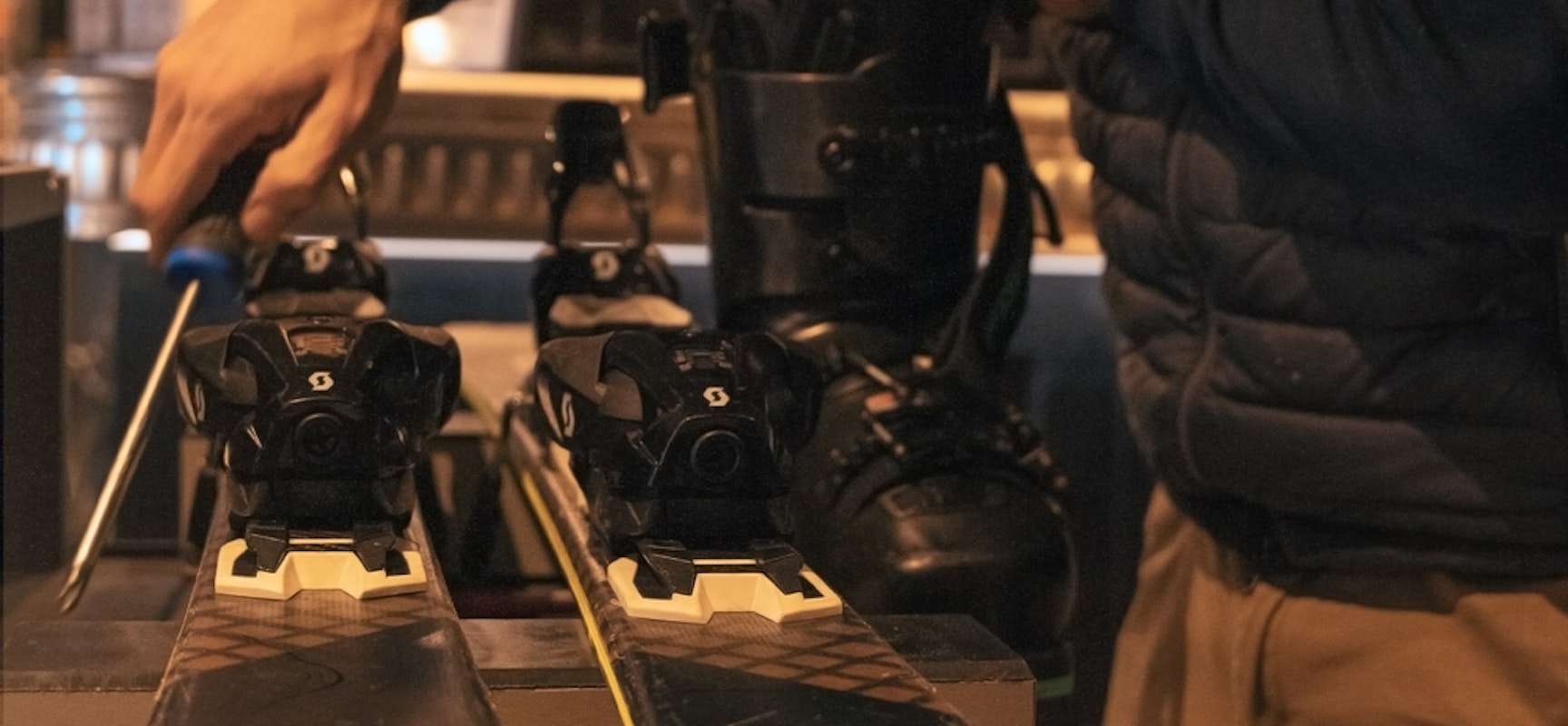
What tools and equipment are needed to sharpen and wax your skis?
Now you’re ready to dive into home ski maintenance. But first, you need to know what to buy—without overspending or accumulating unnecessary gear. Let’s take a look at the equipment you’ll need, from the bare essentials to the professional tools that will serve you season after season.
- Files with different grits
- Angle guide brackets
- Diamond stones
- Edge trimmer
- Clamping device
- Wire brush
- Waxing iron
- Temperature-specific wax
- Plastic scraper
- Nylon/bronze brush
- Finishing brush
- Vise or workbench
- Elastic straps to secure ski brakes
- Protective gloves
- Cleaning cloth or brush
When it comes to brands, Vola and Swix dominate the market, offering complete ranges that cover all needs. Whether you’re a beginner or an experienced skier, you’ll find tools suited to your level and goals—whether for basic maintenance or more precise work on your edges and bases.
Maintaining your skis is just like taking care of your other equipment, such as bindings or technical clothing. Good equipment lasts for several seasons and quickly pays for itself.
Kit type | Benefits | Disadvantages |
|---|---|---|
All-in-one beginner kit | Everything you need in one go, learning made easy | Quality sometimes just right, basic tools |
Complete professional kit | Durable tools, maximum precision | Substantial investment, technical complexity |



Understanding sharpening angles: which settings are best?
Two angles are important when sharpening your skis. The edge angle, also called Angle A, defines the tilt of the edge relative to the ski base. The fall angle, or Angle B, corresponds to the tilt of the sidecut. Together, these angles affect your grip, ease of turning, and the longevity of your sharpening.
Looking for versatility? Aim for 87–89° on your piste skis. This range works well on all types of snow at Méribel-Mottaret, from icy mornings to soft spring-like afternoons. Competitors usually go for narrower angles, around 85–87°, which bite aggressively into hard snow. Beginners often prefer wider angles, around 89–90°, which are more forgiving of small technical errors.
Some skiers fine-tune further by adjusting different zones of the ski. A slightly tighter angle at the tip and tail improves grip when entering and exiting turns, while the middle section is set softer for smoother control.
Be careful with extremes. Edges that are too aggressive can make your skis pivot abruptly at the slightest movement, while edges that are too soft can cause sideways slipping in tight turns. Find the balance that suits your actual skiing style and conditions.
How to sharpen your skis yourself?
Preparing the workspace
Set up in a clean, well-lit area.
Secure your skis in a vise or on a stable workbench.
Fasten the ski brakes with rubber bands to free the edges.
Ensure your skis are completely stable—stability is key for precision.
Edge inspection and cleaning
Use a wire brush to thoroughly remove dirt and debris.
Inspect the entire edge for rust or damage.
If the base plate extends over the edge, clear it with the appropriate tool.
Ensure the edge is completely clean before sharpening.
Choosing and setting the sharpening angle
Set your angle guide to the desired angle (usually 87–89°).
Insert the file into the guide, following the markings.
Make sure the assembly is secure and stable before sharpening.
File sharpening
Place the angle guide flat on the ski base.
Make steady, even strokes from tip to tail.
Apply consistent pressure without forcing the file.
Perform 3–5 passes, depending on the condition of the edges.
Clean the file regularly during use.
Finishing with diamond stone
Gently run the stone along the freshly filed edge.
Smooth out any burrs that catch on the edge.
Use gentle, progressive strokes throughout.
Final polishing and inspection
Run your fingernail perpendicular to the edge—it should catch slightly.
Slide your finger along the edge—there should be no irregularities.
Visually inspect the edge for a consistent shine along its entire length.
Common mistakes and precautions
Never press too hard on the file—this will wear down the edge prematurely.
Avoid letting filings build up on the base or in your tools, as they can scratch and damage surfaces.
Always protect your hands with gloves—edges are very sharp.
Clean your file and edges regularly—maximum efficiency depends on it.
Be careful not to over-sharpen. Winters often bring icier snow, and some skiers push for very aggressive edges to improve grip. However, overly sharp edges increase the risk of cuts during a fall. It’s essential to find the right balance between grip and safety.